Author: Olaperi Okuboyejo

  • Having Devotions: Fuelling your hunger for God

    Having Devotions: Fuelling your hunger for God

    Hello there!

    Welcome to the second part of the series on ‘Having Devotions‘. If you are yet to, please read the first part here.

    In the first part of this series, we concluded that the first step to having a consistent and effective devotional life is to have a hunger and thirst for God. In this post, I’ll share with you practical ways in which you can fuel that hunger for God. Again, we’re still laying the foundation required for our devotional life. Without this hunger, our devotional time with God cannot be sustained or effective.

    What does a hunger for God mean? It means a strong desire and longing for God. Psalm 42:1 says: As the deer longs for streams of water, so I long for you, O God.

    If we are indeed hungry for God, he’s going to fill us up – Matthew 5:6

    Blessed are those who hunger and thirst for righteousness, for they will be filled. (NIV)

    You’re blessed when you’ve worked up a good appetite for God. He’s food and drink in the best meal you’ll ever eat. (MSG)

    So how then can we cultivate this hunger and thirst?

    • Pray for it. If you desire to hunger for more of God, then pray for it. Oftentimes, we want to use our abilities to do God’s bidding.  Meanwhile, God is waiting for us to reach out and ask for help. A sincere prayer from your heart: Lord, I desire to long for you more, I want to be hungrier and more passionate about you, help my heart, oh Lord. Show me how to cultivate a hunger and a thirst for You, Oh Lord. According to your word in Romans 5:5, may the Holy Spirit spread the love of Christ abroad in my heart. Yes, it’s as simple as that. Pray it daily and every time you remember your need to love God more. I pray that God will stir up our hearts towards Himself in Jesus name. Amen. 🙏
    • Use your ears – Listen up. Yes, you can use your ears to cultivate a hunger and thirst for God. Deliberately listen to things that will stir you up. Listen to worship music playing; listen to Christian messages from people your heart connects to; listen to the audio Bible. One thing that also stirs me up is listening to interviews, interviews of men and women of God doing great things in the kingdom. Oftentimes, their stories inspire me to long for God and press for more.
    • Use your mouth – Declare it: If you are really struggling with devotion to God, you need to declare it and speak it to yourself. Take Psalm 42:1-2 and speak it to yourself. Speak it to yourself until it becomes your reality. Our mind follows in the direction of our spoken word, and when you speak God’s word, it’s so powerful that it creates what is being spoken.

    As the deer pants for streams of water, so my soul pants for you, my God. My soul thirsts for God, for the living God. When can I go and meet with God?

    • Fellowship with other believers: For they go from strength to strength, everyone that appears before God in Zion (Psalm 84:7). Make time to join other believers in fellowship and in church services. And when you do go to church, amidst the distractions, try to maintain your focus on God. It’s like a power charger. When you join in fellowship, you turbocharge your spirit man, and you’re empowered. You’re able to then take that empowerment into your own personal life.
    • Use your time. Yes, time is needed in our devotion, but even yet, time is needed to build that hunger for God. You need time to listen and declare as discussed above. You need time to fellowship with other believers. Shift your time, shift your focus, and use it for what matters most. Invest your time daily in building that hunger for God.
    • Cut off. Yes, you need to cut off things that take your devotion away from God. Cut off your excessive time on social media, on watching TV, so that you can make time for what matters, and make time for the One that matters.
    • Use your will. Be deliberate, focus on your hunger for God and choose to desire God. You can work up your appetite for God. 1 Peter 2:2

    Be assured that when you come with a hunger and thirst for God, God will satisfy you. As it is written in Psalm 107:9 “For he satisfies the thirsty and fills the hungry with good things”.

    If you are interested in joining a Group Coaching Call (in the future) for further support on Having Devotions with God, please fill in this form to join the waitlist: https://forms.gle/rd9DYqVfm3N9RwHb6

  • Having Devotions

    Having Devotions

    Hello there!

    Great to have you here. On this blog, I share faith-inspired content on how to live a purposeful life. In this series, I am sharing about Having daily devotions with God. This is a topic that has been on my mind for a while now. And we’ll be looking at the importance and the secret to having effective and consistent daily devotions with God.

    But first, what does ‘devotion’ mean? In this context, a devotion refers to your personal quiet time with God, when you decide to pause other activities to spend time with God in worship, prayer and study of the Word. It is a deliberate act of communing with God.

    So, before we get onto the post, how would you assess your devotional life? Do you have consistent devotions with God? Has it been a long time since you had that personal devotional time just to worship God and commune with Him? When do you have your devotional time – is it scheduled, or do you just see how your schedule goes?

    And when you do have your devotional time, what do you do? Do you read your Bible? Do you pray, do you worship? Do you get distracted, or are you really able to make time out for God? I want you to assess yourself and ask, “What is my devotional life like?” This is important because an honest assessment is required for growth in any area of life. If you understand the current state of your devotional life, then you will know whether you’re doing well, whether you want to improve on it, or whether you actually need to start it.

    Primarily, God wants a relationship with us, and a devotional time is very important because that is one way that we are able to pause, reflect and commune with God. We’re able to pause and worship God and pray to Him, relate to Him, and also hear from Him by reading His Word.

    John 15:15 TPT: [15] I have never called you ‘servants,’ because a master doesn’t confide in his servants, and servants don’t always understand what the master is doing. But I call you my most intimate and cherished friends, for I reveal to you everything that I’ve heard from my Father.

    Why is a daily devotional time with God important? God wants to have fellowship with us. God wants to be our friend – just like with the disciples as seen in that Bible verse John 15:15. God wants us to abide in Him, and He wants to abide in us. God loves us and desires our devotion to him. Setting aside time to fellowship with God is primarily for that reason – fellowship. Beyond what we stand to get from God, He desires our fellowship. Imagine this, the Creator – God Almighty Himself, is knocking at your door, asking for some time with you – are you shunning him, or making excuses about meeting him later, are you too busy for the one who matters most?

    1 Corinthians 1:9 (TLB) – God will surely do this for you, for he always does just what he says, and he is the one who invited you into this wonderful friendship with his Son, even Christ our Lord.

    Personalize this: God wants to fellowship with me. God wants to be my friend. God wants to relate with me. And my having a devotional time with Him is me responding to say, “Yes, Lord, I also want to fellowship with you. I also want to be your friend. I also want to know you.” 

    Yes – God wants us to know Him. God loves us, even before we loved him and He’s constantly reaching out to us.

    Jeremiah 29:13-14: [13-14] “When you come looking for me, you’ll find me. “Yes, when you get serious about finding me and want it more than anything else, I’ll make sure you won’t be disappointed.” God’s Decree.

    Your devotional time is responding to God’s love for you. Not having a devotional time is saying, “God, I’m not quite interested. There are other things that are more important than fellowship with you right now. There are other things that are more important than knowing you right now.” “There are other things that are more important than you.” That’s what not having a devotional time with God means. And it also indicates pride. “I’m fine by myself. I can do it by myself. I don’t need you, God. I can run my life myself”.  Take a moment to pause to think about that. If you go a week without communing with God, what does it mean – you’re too busy at that time for Him, and you don’t really see your need for fellowship with Him.

    That is basically what it means. So being able to have a devotional time with God is really about our hunger and our thirst for Him. Do we still hunger for and desire Him? Do we still thirst for Him and long for Him? Do we still stand in awe of Him?

    Let us remain in awe of Him, in hunger for Him, and then having a devotional time with God will just tend and flow from that point.

    Prayer: Father, give me fresh hunger and reverence for you. Give me fresh awe of you. Give me a fresh hunger and desire for you. In Jesus’ name. Amen.

    If you are interested in joining a Group Coaching Call (in the future) for further support on Having Devotions with God, please fill in this form to join the waitlist: https://forms.gle/rd9DYqVfm3N9RwHb6

  • The Power of Words (Part 2)

    The Power of Words (Part 2)

    Hi there, welcome to another blog on The SignPost!

    In a recent blog, I wrote about the Power of Words; please read it if you are yet to do so.

    Here’s an additional perspective as I continued my reading on the book of Acts. Sometimes, we are quick to speak vile and insulting words to people. This is not right.

    James (Jacob) 3:9-10 TPT

    [9] We use our tongue to praise God our Father and then turn around and curse a person who was made in his very image! [10] Out of the same mouth we pour out words of praise one minute and curses the next. My brothers and sisters, this should never be!

    Even more importantly, we are to be mindful of the words we speak about our rulers and God’s servants, even when they are in the wrong.

    In the book of Acts 23, as Paul faced trial, a man named Ananais had ordered Paul to be slapped wrongly. Paul spoke sharply against him, not knowing that he was the high priest. When he was informed and reprimanded for his words, he quickly apologised, stating that we are not to speak evil of our rulers.

    And that brings us to the next point: sometimes words can proceed out of our mouths so fast. If you realise you spoke wrongly, be quick to apologise.

    Let’s get back to the Paul story – I hear you say, even when the ruler is wrong? Yes – even when they are in the wrong. We are not expected to speak harshly to them or about them. That’s not our role. Do you think God doesn’t rebuke His own? Of course He does, so let’s leave the rebuke to God.

    The Message Translation of the Bible clarifies this. Paul explicitly stated that the priest didn’t quite behave right; nonetheless, he apologised.

    Acts 23:5 MSG

    [5] Paul acted surprised. “How was I to know he was Chief Priest? He doesn’t act like a Chief Priest. You’re right, the Scripture does say, ‘Don’t speak abusively to a ruler of the people.’ Sorry.”

    Paul was actually referencing Exodus 22:28, from the Old Testament:

    Exodus 22:28 NLT

    [28] “You must not dishonor God or curse any of your rulers.

    Try to read these passages again, even in different versions and meditate on them. Convince yourself of what the scriptures say and decide to stop this act if it’s something you usually do.

    The scriptures are here to guide us on how we should conduct ourselves; from them we learn, unlearn and relearn each day.

    Were you blessed by this post? Please leave your comments below!

    Remain Blessed.

  • The Power of Words

    The Power of Words

    Hi there, glad that you are here. Again, this week, I continued reading from the book of Acts. This time, I was drawn to the power of words.

    My dear friend, words are powerful. Sometimes, I wonder if there’s power in motivational speaking, coaching and similar engagements, but as I read in the book of Acts this week, I see again the great power in spoken word. Let’s see some examples.

    In Acts 19:28, we see how a man called Demetrius, spoke to a group of fellow silversmiths in the Bible, and as recorded, the words he spoke made their ‘anger boil’ and resulted in a riot.

    Acts of the Apostles 19:28 NLT
    At this their anger boiled, and they began shouting, “Great is Artemis of the Ephesians!”

    On the other hand, the Mayor spoke words that dispersed the crowd.

    Acts of the Apostles 19:41 NLT
    And when he had said these things, he dismissed the assembly.

    Paul’s friends spoke words that prevented him from going into the crowd, Alexander spoke words that stirred up the crowd and got them shouting for another 2 hours – the power of words [Acts 19:30 – 34].

    What does this mean for us? It means that there is power in the words we speak and in the words we hear also. The words we can speak can stir up people. It can stir up anger. It can stir up the right decision. It can stir up zeal in the right direction.

    In like manner, the words we hear can do the same. We can hear words that will bring up fear in us, or words that will stir us up in courage.

    Which type of words do you speak? What do you listen to, be watchful, for both are very powerful.

    Prayer: Father, may the words that I speak impart grace to those who hear me, and may I guard my ears and only listen to things that are profitable, in Jesus name. Amen 🙏

    “Let no corrupting talk come out of your mouths, but only such as is good for building up, as fits the occasion, that it may give grace to those who hear.”

  • Great insights on evangelism

    Great insights on evangelism

    This week on our Bible Study Insights, let’s continue our discussion on sharing the good news with others. See previous posts on this discussion: Would you play your part? ; Philip was ready.

    As I continued my reading of the book of Acts, I saw more lessons that we can learn from the apostles’ approach to evangelism.

    • We have to be led by the Holy Spirit on where to go and where not to go, whom to speak with, and, of course, the timing matters too.
      Acts 16:6,7,9,10 –  And they went through the region of Phrygia and Galatia, having been forbidden by the Holy Spirit to speak the word in Asia. And when they had come up to Mysia, they attempted to go into Bithynia, but the Spirit of Jesus did not allow them. And a vision appeared to Paul in the night: a man of Macedonia was standing there, urging him and saying, “Come over to Macedonia and help us.” 10 And when Paul[c] had seen the vision, immediately we sought to go on into Macedonia, concluding that God had called us to preach the gospel to them.
    • We have to meet people where they are. Philip preached to the Ethiopian Eunuch from the passage he was reading (Acts 8:26-40). In Acts 16, Paul preached to the Athenians from their altar/inscription: “To an Unknown God”. We might also need to use different approaches for different people. With some people, the Stoic and Epicurean philosophers, Paul had a debate; with others, he shared from the Jewish scriptures. You need to know your audience so that you know where to meet them.
    • We will be persecuted. Paul was persecuted several times. Almost killed, stoned. Oftentimes, the believers in the area had to sneak him out. At some point, they called them ‘babblers’. We need to grow a ‘thick skin’ towards persecution and mockery, as this will happen. When persecuted or looked down upon, we cannot afford to be offended. Like soldiers, we need to move on. Paul and Silas moved on in worship and prayers to God (Acts 16: 25 -40), even while in jail.

      Though they were beaten and had wounds, they praised God in their wounds. They got those wounds in the place of serving God, in the place of evangelism, yet they weren’t offended with God. Init, Jesus already warned of persecutions. Alas, there was a miraculous release, and even the jailer and his family were saved and baptised that same night.   Even in their pain, because of the right disposition they had, they were able to save an entire household.
    • Keep moving, don’t stop: The apostles didn’t let setbacks set them back at all; it was always an opportunity to move on to the next city to talk about Jesus. Indeed, they spread the gospel of Jesus without looking back.
    • In some spaces, we might need to put down our ‘title’ and level of influence. They were surprised that Paul was a Roman citizen; they didn’t think someone of that calibre, or societal status, would be doing what Paul was doing – going around talking about God (Acts 16:35-38).
    • However, at other times, it is that level of influence that we will leverage on to be able to speak the good news with a certain class of people, or within certain quarters.

    Here are some of my insights from the Bible chapters I read this week. Did you also read your Bible this week, share your insights with others and in the comments!

  • Timing Matters

    Timing Matters

    Timing is important in the execution of our assignments.

    When Moses went ahead of his time, he did wrong; he killed someone. The people he was sent to, his fellow Israelites, didn’t accept him; he eventually had to flee for his life.

    Although he knew he had been sent to free his people, he decided to visit them ahead of time, and it didn’t end well. Anything we do ahead of time doesn’t usually end as planned.

    Let’s read the story from Acts 7:

    23 “When Moses was forty years old, he decided to visit his own people, the Israelites. 24 He saw one of them being mistreated by an Egyptian, so he went to his defense and avenged him by killing the Egyptian. 25 Moses thought that his own people would realize that God was using him to rescue them, but they did not. 26 The next day Moses came upon two Israelites who were fighting. He tried to reconcile them by saying, ‘Men, you are brothers; why do you want to hurt each other?’

    27 “But the man who was mistreating the other pushed Moses aside and said, ‘Who made you ruler and judge over us? 28 Are you thinking of killing me as you killed the Egyptian yesterday?’[e] 29 When Moses heard this, he fled to Midian, where he settled as a foreigner and had two sons.

    23-26

    However, when it was God’s time, God sent him.

    vs 30 After forty years had passed, an angel appeared to Moses…

    At that time, he didn’t want to go anymore; there was fear, which was caused by his going ahead of his time. Notwithstanding, it was then God’s time, and God sent him. He went, and the mission was delivered – the rescue of the Children of Israel from Egypt.

    35 “This is the same Moses they had rejected with the words, ‘Who made you ruler and judge?’ He was sent to be their ruler and deliverer by God himself, through the angel who appeared to him in the bush. 36 He led them out of Egypt and performed wonders and signs in Egypt, at the Red Sea and for forty years in the wilderness.

    Even when we are sure of what God wants us to do, we must also confirm his timing.

    Timing matters!

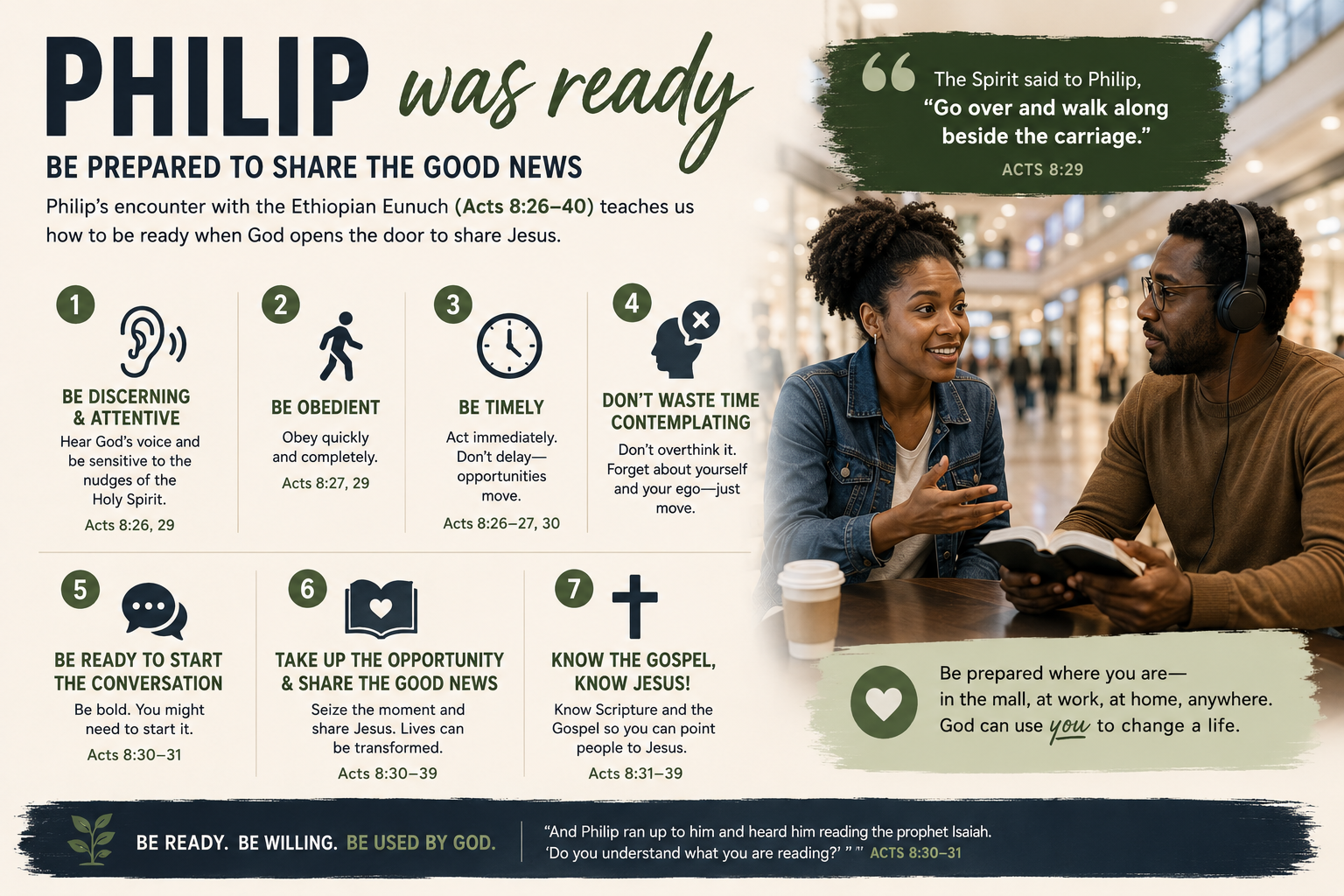
  • Philip was Ready!

    Philip was Ready!

    Imagine you’re in a shopping mall, and God instructs you to go to a particular restaurant in the mall, and as you go in, he asks you to go and sit at a table, directly behind someone. As you do so, you hear the person listening to a podcast and the Holy Spirit nudges you to engage in a conversation with the person, based on the message from the podcast.

    Well, yes, something very similar to that happened to Philip. The full story is in Acts 8:26 – 40.

    In our last conversation,  we talked about how it’s our responsibility to spread the word of God further. And how we must be prepared to do that. Read that blog here.

    Today, I read this story of Philip, and it just occurred to me that Philip was prepared. Let’s learn from Philip what it means to be prepared.

    To be prepared:

    1. We must be discerning and attentive to those nugdes in our heart from the HolySpirit.

      Philip heard the angel of the Lord say to him, “Go south down the desert road that runs from Jerusalem to Gaza”. [Acts 8:26]. He also heard the HolySpirit say to him, “Go over and walk along beside the carriage”.

      If Philip wasn’t able to hear God, we won’t be having this conversation. While in the mall or at work, at the park or in our home, we need to be able to hear God.
    2. We must be obedient.

      Right on the next verse, vs 27, the Bible lets us know, he started out on that path as instructed. Again, he obeyed the next instruction in vs 29 to walk along the carriage he saw. Be prepared to just obey.
    3. We must be timely.

      In vs 26, he was instructed to go to south down, and immediately in vs 27, we saw him do that. Again in vs 30, he ran over, when he was asked to walk beside the carriage. If he didn’t ‘Go south’ immediately, he wouldn’t have been able to see the Eunuch, because the carriage was moving, if he had waited or delayed, the carriage would have been gone. He also needed to quickly run over to walk beside the carriage. If he wasn’t prompt, perhaps the carriage would have been too far gone for him.
    4. Don’t waste time contemplating.

      If he was questioning, ‘why should I go south’? Or if he bothered – ‘why would I just go and walk beside somebody’s carriage’? That’s going into someone’s space. Won’t I look like I don’t know what I’m doing? Be prepared to forget about yourself and your ego, and just move.
    5. Be ready to start the conversation.

      Philip was bold and not shy, he also did his part. The Angel and the HolySpirit had led him, now he had to play his part. Being sensitive, he heard what the man was reading out loud – and started the conversation.

      Yes, be ready to start that conversation. You might need to start it. Don’t wait and say, ‘okay let me just wait for him to say something, then I’ll continue from there’. The other person might not say anything – you start the conversation.
    6. Take up the opportunity and share the goodnews. He took the opportunity, for he was ready.

      Acts of the Apostles 8:30 – 31. Philip ran over and heard the man reading from the prophet Isaiah. Philip asked, “Do you understand what you are reading?” [31] The man replied, “How can I, unless someone instructs me?” And he urged Philip to come up into the carriage and sit with him.

      Philip took up the opportunity and he shared the goodnews.. The man had so much understanding, that he was the one who requested to be baptized.
    7. Know the Gospel, know Jesus!

      Finally, Philip knew what to share. He had read the books of the prophets so much (that was their Bible in that time) that he knew the passage the Eunuch was reading. He also knew about the gospel of Jesus. And beginning from the passage the man was reading, he went on to share the gospel of Jesus.

      Do you read your Bible? Do you know Jesus? Do you know what and who you want to preach about? Philip started out from what the man was interested in and went on to share the gospel of Jesus. If you were to have a conversation today, do you know what to share, or how to lead the conversation and the person to Jesus?

    Think on these points and be prepared to share about Jesus.

    In the next post, I’ll talk about easy ways to have that conversation, and talk about Jesus.

  • Would you play your part?

    Would you play your part?

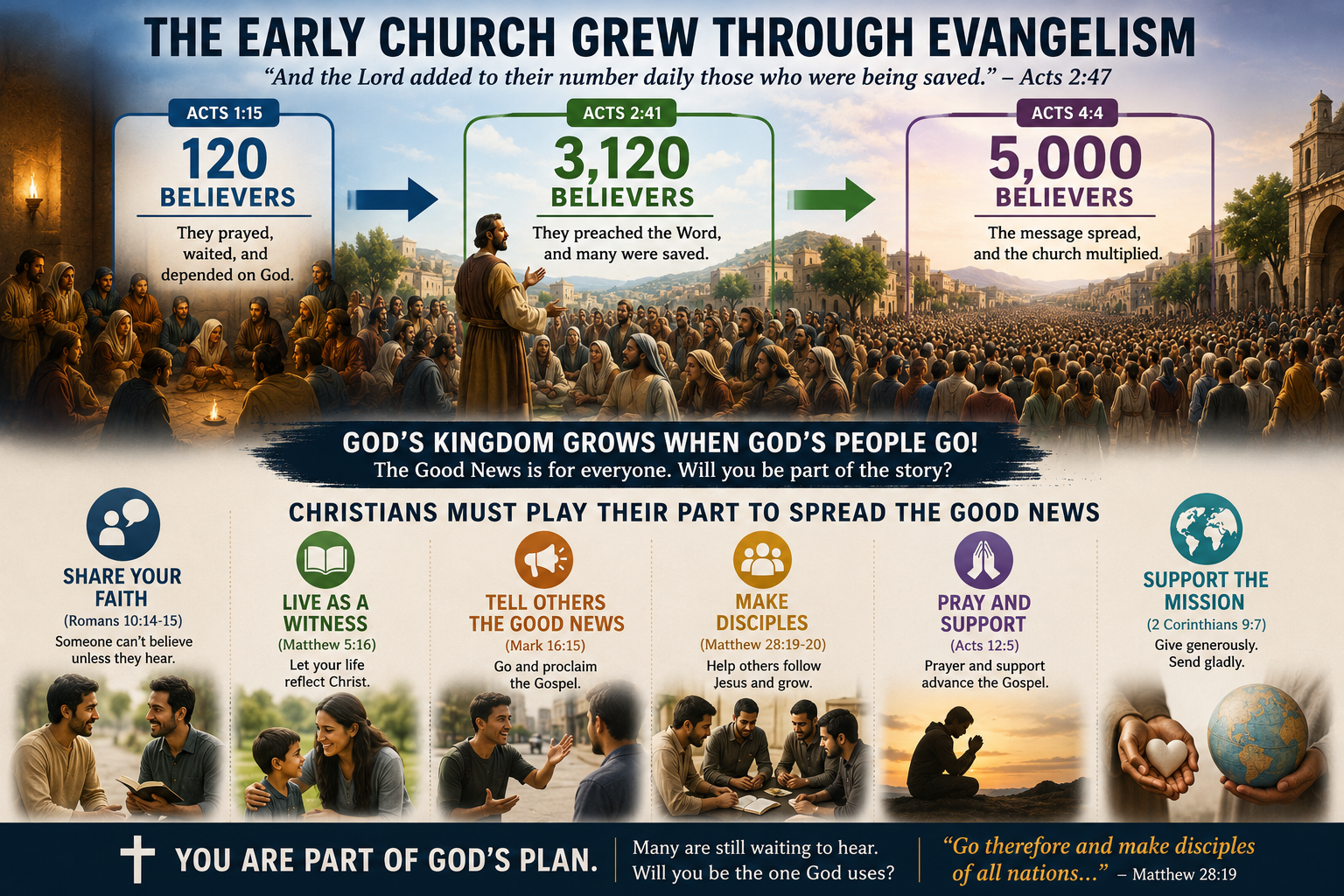
    As I read the first 5 chapters of the book of Acts last week, something struck me. Christianity actually started as just a few group of people – only 120 of them on the day of Pentecost.

    Yet, in those few chapters, they moved to 3,120 and then 5000. How did the numbers increase? have you ever wondered? How did only 120 people know Jesus, and then the numbers suddenly grow to 5000? The answer – Someone told someone!

    Yes, that simple. And guess what? God is actually expecting you to tell someone. In John 17:20, Jesus was already praying ahead, for those who will believe him through your witness,through your word. Are those people already in the faith? Or are they are waiting for you to tell them about Jesus.

    One important secret is to recognize opportunity and seize it. Acts 3:12 states that Peter saw his opportunity and addressed the crowd.

    Peter saw his opportunity and addressed the crowd. “People of Israel,” he said, “what is so surprising about this? And why stare at us as though we had made this man walk by our own power or godliness?

    Are you seeing the opportunity around you? And are you prepared to jump in at that opportunity? Is your story ready? Is your testimony ready – of how Jesus changed your life, and how He can change theirs too.

    The Christians went out and shared the word. If the next increase in the believers of Christ is dependent on me and you, are we playing our part?

    From 120 to 5000 – Are you playing your part? Read the next blog here, on how Philip played his part.

    Prayer: Dear Lord, help me to recognize every opportunity you give me to share the good news of Christ, and let me always be prepared to tell others about you.

    How can I be prepared to share the good news of Jesus?

  • Busy Versus Productive (Fruitful).

    Busy Versus Productive (Fruitful).

    Busy Versus Productive (Fruitful).

    So, let’s get on to our series on Time Management.

    I once heard the statement, “If you are too ‘busy’, then you’re doing too much”.

    But wait a minute, should we actually be busy or productive, aka fruitful? Have you been busy, or have you been productive? Hmm… Is there a difference between the two words?

    For the sake of this conversation, being busy means being occupied, yeah, literally busy doing something. A roller coaster is busy, right? It just moves round and round and round. You are not just lazing around, sleeping and lying down all day – you are engaging in activities.

    On the other hand, being productive – fruitful implies that there’s fruit – an outcome of being ‘busy’. Did your time being busy yield any results? Or like the roller coaster, did your To-Do list only move around – nothing actually checked off the list.

    At the end of the day, are you able to pinpoint what you achieved for the day? Are you able to account for the 24 hours that just passed? Are you just busy, or are you also fruitful?

    Not to worry, that is what this Time Management Series will be about – how to move you from just being busy to being productive.

    Just one tip for this post – Planning.

    Proverbs 21:5 – Good planning and hard work lead to prosperity, but hasty shortcuts lead to poverty. (NLT)

    That Bible verse says it all, most times, we jump into the day so hastily, yet we expect a productive day. What about spending some time to sharpen the axe, before attempting to cut down the tree?

    Planning helps – Don’t just jump into things, rather, plan them. Give a purpose to every piece of time. Plan out the entire day. Don’t leave anything or portion of time to chance. If you don’t have something to do, others will give you what to do.

    So what are you planning to do by the next hour from now – are you thinking of that right now? Are you shuffling your memory to remember the other deliverables you need for the day?

    Get a piece of paper, notebook, digital planner – and write down something for every single hour of the day – that’s how to start.

    Seems like we’re moving from bottom-up, but yes, the secret is to just start and then refine. Over the next posts, I will discuss some guidelines to planning, some tips and tools. I have tried different tools, but one that is currently suited for me right now is Google Tasks – I am able to use it for both my personal and domestic tasks and my office tasks. We’ll talk more about that in subsequent posts.

    For now your action point should be this – write down what you plan to do in every hour of each day. See you in the next post!

  • The Second Great Commission.

    The Second Great Commission.

    How often we talk about The Great Commission – Jesus’s final words and instructions to the church, as recorded in Matthew 28:16-20. 

    Alas, I discovered another Great Commission, which we rarely talk about. Again, another of Jesus’s last words to his disciples. This time, not about what we should do to the world, but what we should do to ourselves, to our fellow believers and disciples.

    My discovery, by the inspiration of the HolySpirit is found in the book of John.

    John 13:34-35 NLT:

    [34] So now I am giving you a new commandment: Love each other. Just as I have loved you, you should love each other.

    [35] Your love for one another will prove to the world that you are my disciples.

    Jesus instructed us to love one another. That was His commandment to us, in His final moments. This instruction, or better yet – commission is so important because, it’s actually how we will prove to the world that we are His disciples. 

    My question to you is this, are you obeying and observing these words of Jesus? Are you loving one another? Are you loving other members of the body of Christ, both within your local assembly and outside your local assembly?

    May the Lord, help us to love in deed and in truth, that we may show to the world, that we are indeed His disciples. Our guiding principle, is to love.

    So what then does it mean to love? Next Post Loading…